
Blog
Launching a financial media network: A roadmap for financial services leaders
Published January 29, 2026
by Sarah Wheeler

From data advantage to scalable growth
Financial institutions sit on some of the richest, most trusted first-party data in the digital economy. Banks, credit card issuers, and fintech platforms understand their customers’ intent, spending behavior, and lifecycle milestones better than almost any other industry. Yet when it comes to commerce media, that advantage has not consistently translated into mature, scalable media networks.
New research from Forrester Consulting, commissioned by Koddi, shows that financial services organizations are advanced in data maturity but cautious in media execution. Strong governance, compliance, and measurement discipline are strengths, but they can also slow activation, limit creative experimentation, and constrain scale. For senior leaders evaluating whether and how to launch a financial media network, the challenge is not whether the opportunity exists, but how to unlock it responsibly and in a way that aligns with regulatory and operational realities.
This article outlines a practical roadmap for launching a financial media network that aligns with regulatory realities, protects consumer trust, and delivers measurable growth for advertisers, consumers, and networks alike.
Why financial media networks matter now
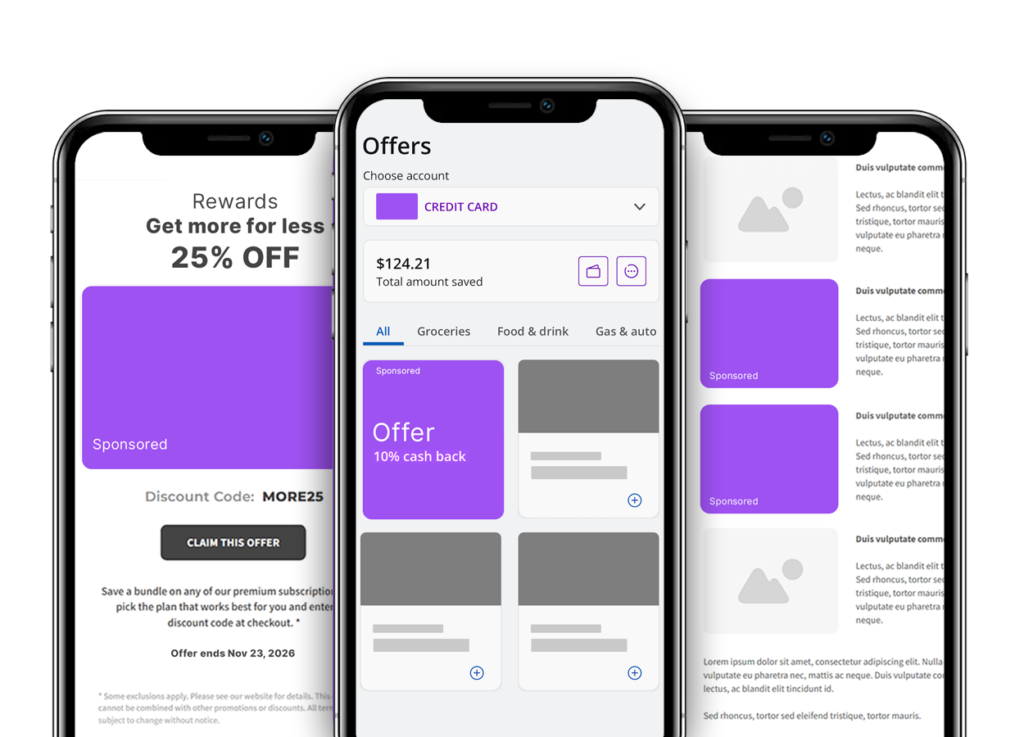
As commerce media evolves beyond retail, any digital environment where authenticated users transact, research, or make high-value decisions can become a media surface. For financial services, that includes:
- Mobile banking and credit card apps
- Loan, mortgage, and financing journeys
- Loyalty, rewards, and card-linked offer ecosystems
- Embedded finance and checkout partnerships
These environments offer high-intent attention paired with deterministic data. Advertisers value the ability to connect media exposure to approved accounts, card activations, funded loans, or downstream spend, outcomes that are directly tied to revenue.
Yet most financial services organizations remain in early or emerging stages of media maturity. Many rely heavily on a narrow set of placements, such as cobranded offers, and manual workflows. These approaches are often effective as pilots but difficult to scale without introducing operational strain or compliance risk.
Launching or expanding a financial media network hinges on translating data leadership into repeatable, governed media execution.
What the data says: Where financial services really stand today
Forrester’s study, “All commerce media playbook,” commissioned by Koddi, highlights a consistent pattern: financial services organizations are constrained by activation, not data. In the maturity assessment across seven industries, financial services ranked second only to retail. However, that ranking reflects strength in governance, measurement, and accountability rather than widespread deployment of scalable media products.
Several findings from the research illustrate this imbalance:
- 26% of financial services respondents report offering full-funnel commerce media, a figure driven largely by confidence in measurement and attribution rather than broad omnichannel activation.
- 90% identify strengthening measurement and attribution as a critical or high priority, reinforcing how central accountability is to media investment decisions.
- 87% prioritize improving targeting and personalization using first-party data, signaling confidence in compliant data usage.
At the same time, 67% cite regulatory approval and creative review as a major barrier, and only 19% currently use AI-driven optimization. These constraints point to operational bottlenecks rather than strategic hesitation.
Financial services has established trust and precision. Scaling activation remains the unresolved challenge.
What financial services should learn from other industries
One of the most valuable takeaways from the playbook is that commerce media maturity is uneven across industries, but best practices travel well. Financial services leaders can accelerate their own progress by selectively borrowing what other sectors already do well.
From retail: how to scale without damaging experience
Retail media networks demonstrate how to increase ad load and inventory diversity without degrading user experience. Retail leaders have normalized sponsored placements as part of the digital shelf and are steadily expanding into offsite and in-store formats.
For financial services, the lesson is to adopt retail’s discipline around:
- Building for outcomes, not impressions. Advertisers care about new customers, wallet share, and lifetime value, and so should network operators.
- Self-serve and templated activation models that reduce operational friction. In mature retail media platforms, AI-empowered self-serve tools increasingly drive both velocity and quality at scale.
- Centralized orchestration across formats, even when execution spans multiple teams. The strongest retail media networks connect onsite, offsite, CTV, and in-store into one story
From travel: activating intent beyond the moment of transaction
Travel and hospitality networks excel at activating media across discovery, booking, and post-purchase phases. While their measurement challenges differ, they offer a critical lesson for financial services: value is created well before conversion.
Financial services organizations tend to concentrate media around checkout or account-opening moments. Travel demonstrates the upside of engaging earlier, when consumers are researching, comparing, and planning, and using contextual relevance to influence decisions upstream.
Learn from transportation and logistics: operational data as media signal
Transportation and logistics networks are early in commerce media maturity, but they are beginning to turn real-time operational data into contextual media opportunities.
Financial services can apply the same thinking by treating signals like:
- Payment timing
- Category-level spend patterns
- Lifecycle milestones
as contextual inputs, not just reporting outputs. This reframing turns internal operational data into high-value media intelligence.
How financial services can create a standout commerce media offering
To differentiate in a crowded and cautious market, financial services media networks must lean into what makes them structurally different and valuable.
1. Make privacy and trust a feature, not a constraint
Financial services already operate with some of the strongest consent and compliance frameworks in digital media. Rather than treating this as a limitation, leading networks position it as a competitive advantage.
Privacy-safe data collaboration, including encrypted attribution and clean environments, enables advertisers to measure impact without exposing sensitive customer data. In a market increasingly shaped by regulation and signal loss, this level of trust is rare and valuable.
2. Lead with outcomes that matter to the CFO
Unlike many media environments, financial services platforms can tie exposure to approved, regulated outcomes. The research shows that incrementality and ROAS already guide two-thirds of financial services media investments.
Standout networks go further by:
- Designing measurement around approved accounts, funded balances, or usage
- Aligning reporting to finance and risk stakeholders, not just marketing
- Treating measurement as the primary product, not an afterthought
This is where financial media networks earn credibility and repeat spend.
3. Expand context without expanding risk
Nearly half of financial services respondents are already exploring cobranded checkout placements and embedded finance partnerships. These are safe starting points, but they should not be the end state.
Growth comes from adjacent, high-intent contexts, such as travel bookings or major purchases, where financial products are naturally relevant. The key is selective expansion: fewer environments, deeper integration, and strict governance.
4. Automate within guardrails
The data shows that reliance on manual creative review and limited AI adoption is a primary bottleneck for financial services media networks. Preapproved creative libraries, modular templates, and rule-based optimization allow teams to move faster without sacrificing oversight.
Automation does not remove control; it standardizes it.
A clearer path forward for financial services leaders
The research reinforces a central truth: to win in commerce media, financial services need to translate its existing strengths of data discipline, trust, and accountability into scalable activation models.
The leaders who succeed will be those who:
- Borrow selectively from other industries without copying blindly
- Treat measurement as the core product
- Use automation to enforce governance, not bypass it
- Expand context thoughtfully, with relevance and trust as non-negotiables
Financial media networks will not be built overnight, and they don’t need to: begin simply and intentionally constrained. Start with one owned surface, one clearly defined outcome metric, and one advertiser category.
For banks, card issuers, and fintech platforms willing to evolve beyond pilots, the opportunity is clear: turn financial ecosystems into durable, outcome-driven media platforms that advertisers trust and return to again and again.
GET IN TOUCH
Ready to get started?
Don’t let your brand get lost in the noise. Partner with Koddi to unlock the power of commerce media and transform the way you engage with your customers. Our team of experts is here to help you navigate complexities and develop a strategy that drives results — no matter what industry – in as little as 45 days.