
Blog
Behind the scenes of a client QBR: A Program Manager's perspective
By Jess Bolton
What actually makes a QBR (Quarterly Business Review) great? Is it a polished deck, strong visuals, or a compelling narrative?
In my experience, none of those things matter unless the strategy behind them is sound. A great QBR reflects months of ongoing partnership, alignment, and iteration. By the time the meeting appears on the calendar, most of the real work has already happened.
After seven years at Koddi and supporting programs that have scaled significantly over time, I have come to see QBRs as checkpoints, not events. They are moments to step back, assess what has been built together, and decide how to move forward.
Since relocating to Europe to be in the same city as one of our partners (a program that has seen industry-leading growth since its launch four years ago), our collaboration has taken on a new dimension. Being in the same time zone and working alongside their teams allows me to move faster, stay aligned, and operate as a true extension of their business.
What follows is what QBR preparation actually looks like over the course of a quarter.
3 months out: Strategic goal setting
Prep for our next QBR starts the week after the last QBR, even if it does not yet feel like prep. This is where we align on what success should look like and establish a clear strategic focus for the quarter ahead.
While I work mainly 1:1 with this partner, engaging with the broader Koddi team is essential. Every commerce media network we support is unique, with its own goals, product mix, and market dynamics. In our team’s Weekly Business Reviews (WBRs), we step back to assess what we’re hearing from the market, what new ideas we have, and what’s working really well for our teams. With product, data science, support, engineering, and other program managers on these calls, it’s a great way to get outside opinions and support on how to scale the program I’m responsible for growing.
This phase also involves close collaboration with our product teams. We ensure the roadmap reflects the needs of this specific program, including new ad formats and custom decisioning strategies planned for upcoming launches. These conversations are forward-looking and deliberate. Does this deliver the expected revenue impact? How does it support advertiser growth and incremental value for the business?
Because the program has grown rapidly over the past several years, goal setting requires pressure testing assumptions early. We look closely at whether momentum in high-potential regions is strong enough and whether new experiments are truly driving incremental outcomes.
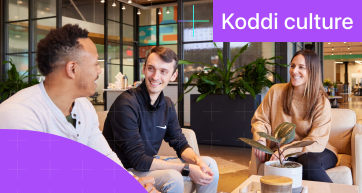
This is where Koddi’s culture is deeply embedded. Even though I’m based in Europe now, constant Slack collaboration keeps ideas moving between time zones. Daily spend milestones or key advertiser launches are celebrated by everyone, reinforcing that this is a shared effort that teams are proud of.
2 months out: Strategy in motion
Two months out is where strategy begins to show results.
At this stage, the focus shifts to understanding how initiatives are performing and where refinement is needed. I closely monitor how advertisers are engaging with new features and placements and where early signals suggest opportunities to iterate.
Monitoring new experiments allows us to evaluate how changes are impacting advertiser behavior and engagement, and to refine our approach as results emerge across different markets. These insights help inform where to invest further and where adjustments are needed to support long-term growth.
Advertiser experience is also a key focus during this phase. While I primarily partner with the commerce media network team, our sales and support teams work directly with advertisers every day. As the network has scaled to more than 40,000 advertisers, delivering consistent, high-quality support has become increasingly important.
One area I watch closely is our AI support agent. Today, it resolves roughly 70% of live chat inquiries with an average CSAT +90%, allowing our human teams to focus on more complex, strategic conversations. These insights shape how we think about support and how we ultimately frame that story in the QBR.
1 month out: Partnership in practice
One month out, the focus shifts from collecting signals to synthesizing them.
Since relocating, I spend every week embedded in the client’s office, sitting alongside their team. This proximity matters. It creates shared context and allows conversations to happen naturally, with a bias toward real-time solutioning.
On a typical day, this might be giving a commercial specialist a demo of a new feature we’re building. The goal is immediate clarity and applicability, ensuring teams can take concrete recommendations directly to advertisers.
Being present allows for real-time feedback. If something is unclear or not landing as intended, that insight goes directly back to our product team. We adjust quickly. By the time we reach the QBR, the strategy reflects months of collaboration and iteration rather than last-minute alignment.
2 weeks out: Turning insight into narrative
Two weeks out, the deck starts to come together. The focus is on clarity and overall flow.
I translate months of data, conversations, and learnings into a cohesive narrative. A global performance review is not just about reporting results. It is about explaining what changed, why it changed, and how those insights inform what comes next.
Even in a program as mature as this one, there’s still significant opportunity across markets and advertiser portfolios. Close alignment across commercial, product, and data science ensures we walk into the room with a unified point of view and a plan for how to attack the opportunity.
3 days out: Finishing touches
Three days out, it’s really just about the finishing touches now.
Teams across commerce media, product, data science, support, and ad sales walk through likely questions and responses. We align on how we talk about new formats, roadmap timing, and what working together looks like going forward.
By this point, there is shared confidence. Everyone understands the narrative, the data, and the strategy.
The QBR
When a great QBR happens, it feels like a continuation of the partnership rather than a standalone meeting.
The agenda reflects the partner’s priorities, including a global review, expansion initiatives, and plans to deepen adoption.
We walk into the room not as outsiders pitching a service, but as colleagues solving shared problems. We celebrate the wins, but we also dive deep into the challenges. We don’t hide the data: we use it to build our roadmap and the basis for the next QBR.
By the time we head to dinner that evening, the “business” talk fades (hopefully), and the relationship building continues to cement.
To me, it comes back to this: you can show a client industry-leading growth, but if you don’t understand their pressures and their goals, you’re just a vendor.
At Koddi, we partner deeply with our clients to drive outcomes that matter, not just metrics that look good on a slide. We listen, share ownership of the wins and the hard moments, and commit to the long run. That’s the difference between a quarterly meeting and a true partnership. And it’s how we make growth happen year after year.
GET IN TOUCH
Ready to get started?
Don’t let your brand get lost in the noise. Partner with Koddi to unlock the power of commerce media and transform the way you engage with your customers. Our team of experts is here to help you navigate complexities and develop a strategy that drives results — no matter what industry – in as little as 45 days.