
Blog
How Semantic Search unifies organic and sponsored decisioning across the page
By Desmond Decker

Most commerce media networks have heavily invested in improving organic search and personalization. At the same time, sponsored placements have evolved with better targeting, bidding, and optimization. Both systems work well on their own, but they don’t always work together on the page.
The result is a fragmented experience where organic and sponsored products are evaluated using different criteria, even though they’re competing for the same shopper’s attention. When that alignment breaks down, relevance suffers: click-through rates fall, advertiser performance declines, and retailers lose out on both conversion and monetization. Viewed side-by-side, the difference becomes clearer.
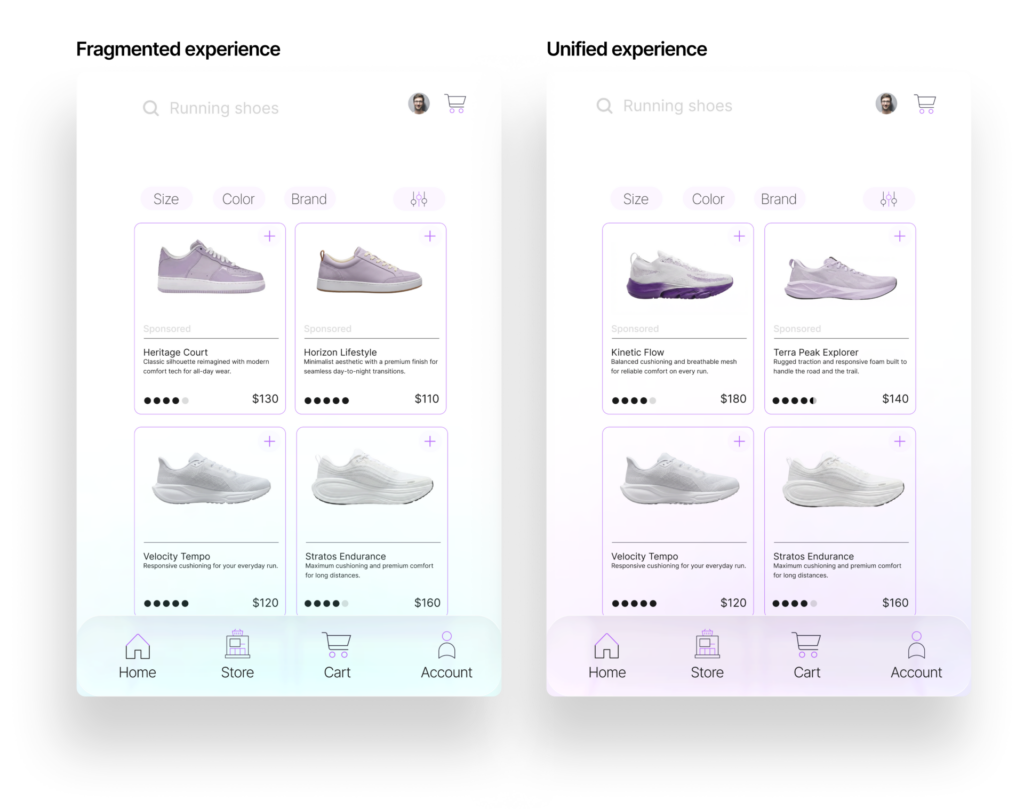
The problem: Two systems operating on one page
In most systems, organic results and sponsored placements are still driven by separate decisioning frameworks. Organic rankings typically center on relevance and taxonomy, while sponsored placements are influenced by bids and targeting signals. Even when both systems perform well independently, they’re rarely designed to optimize together.
This gap becomes visible in the final page layout. Products that look relevant on their own may feel out of place in context, creating an inconsistent experience for shoppers. Solving this requires unified decisioning that scores every product, organic and sponsored, through the same understanding of shopper intent, page context, and expected performance.
Why blending organic and paid breaks down
Blending organic and sponsored results is not just a ranking problem, but a coordination problem across systems that weren’t built to work together. Even as each system has matured, gaps can still emerge.
Different scoring standards: Organic ranking optimizes for taxonomy-aligned relevance and shopper experience. Sponsored decisioning adds bids, budgets, and targeting, so placements that “win” in isolation can feel incoherent when positioned side by side.
Inconsistent context signals: Organic systems typically ingest richer context, including taxonomy structure, browsing behavior, and inferred intent. When sponsored decisioning relies on a thinner view of context, promoted products drift from what shoppers are actually exploring.
Retrieval constrains rankings: Rigid, exact-match retrieval can exclude relevant products before ranking even starts. That limits what the ranking layer can optimize because it cannot score candidates it never sees.
Guardrails are often insufficient: Broader matching can improve coverage, but without strict, taxonomy-aware guardrails, it may surface ads outside the surface intent and erode trust.
The result is a page that feels pieced together, with relevance evaluated in fragments instead of a single, unified experience.
A shared foundation for relevance
To drive more consistent decisioning across the page, Koddi deployed its Semantic Search system as a relevancy layer that runs directly on the retailer’s existing catalog and taxonomy. Importantly, this system aligns with the same inputs that inform the organic experience, without requiring a new ranking model.
At its core, Semantic Search builds a unified representation of catalog attributes and shopper context, so candidates can be retrieved through semantic alignment rather than exact matches. This approach expands eligible coverage while maintaining relevance, even when inputs are incomplete or inconsistent.
Taxonomy-aware guardrails then protect page-surface integrity, ensuring broader matching never surfaces results outside of the intended context.
Together, this shared context enables both sponsored and organic products to be evaluated through the same consistent relevance lens.
Applying that foundation to decisioning
Building a shared understanding of context is only the first step. The real impact comes from how that context is applied at the decisioning layer.
Semantic Search applies the same underlying context in the organic experience to sponsored decisioning, evaluating placements against a consistent standard for relevance. The result is a more cohesive page experience.
This coordination comes from:
- Shared context and semantic retrieval: aligns search intent, taxonomy, and product attributes so all candidates are judged on the same signals.
- Strict, taxonomy-aware guardrails: enforce publisher-defined relevance standards, ensuring placements align with the taxonomy of each page’s surface.
- ML-driven ranking and optimization: uses behavioral signals, historical performance, and ad inputs to balance relevance and monetization in real time.
This approach goes beyond improving ad performance: it creates more consistent relevance across the entire shopping experience, thus helping retailers better align merchandising, capture additional demand, and improve monetization quality over time.
Better outcomes across commerce media
Improving how sponsored relevance is determined and enforced can deliver measurable lifts throughout the customer journey.
In this deployment, the retailer saw:
- +21% click-through rate (CTR)
- +32% return on ad spend (ROAS)
- +19% conversion rate (CVR)
These results reflect what happens when placements align more closely with true shopper intent. More relevant ads maintain a more seamless experience for shoppers, and therefore, earn stronger engagement, convert at higher rates, and generate better returns for advertisers.
Notably, these gains came without increasing ad load or expanding inventory. The lift was driven by improving the quality and contextual fit of each placement.
The future is a unified shopping experience
As commerce media evolves, the line between organic and sponsored results will continue to blur. What really matters isn’t the label, but whether the product actually fits the shopper’s needs.
The retailers that win will be those that can apply relevance consistently across the page, aligning merchandising and monetization through a shared understanding of context and intent.
This is the path toward a more unified shopping experience: one that feels seamless to shoppers and rewards brands based on performance, not just spend.
Frequently asked questions
What is Semantic search in commerce media?
Similar to Vector Search, Semantic search uses machine learning to understand the meaning and intent behind a shopper’s query rather than relying only on exact keyword matches. In commerce media, it can help identify sponsored products that are relevant to what a shopper means, even when the product listing uses different language.
How does Semantic search improve sponsored product relevance?
Semantic search can match queries and products based on meaning, context, and similarity, expanding the set of relevant products beyond exact keyword matches. This can create more opportunities to serve useful ads while reducing irrelevant placements.
What is the difference between Semantic search and keyword targeting?
Keyword targeting relies primarily on explicit words or phrases to match queries with products or ads. Semantic search represents the underlying meaning of queries and products, allowing the system to recognize relevant relationships even when they do not share the same exact keywords.
How does AI improve ad relevance in commerce media?
AI can evaluate signals such as shopper intent, product attributes, context, historical engagement, and predicted outcomes to determine which ads are most relevant for an opportunity. This can improve the shopper experience while helping advertisers achieve stronger performance.
How can AI improve sponsored product performance?
AI can improve sponsored products by expanding relevant query-product matches, predicting engagement and conversion likelihood, optimizing bids and pacing, and identifying performance opportunities. The goal is to improve both advertiser outcomes and the relevance of ads shown to shoppers.
GET IN TOUCH
Ready to get started?
Don’t let your brand get lost in the noise. Partner with Koddi to unlock the power of commerce media and transform the way you engage with your customers. Our team of experts is here to help you navigate complexities and develop a strategy that drives results — no matter what industry – in as little as 45 days.